
Balbir Singh
Published on Oct 23, 2026 on leftviews.in
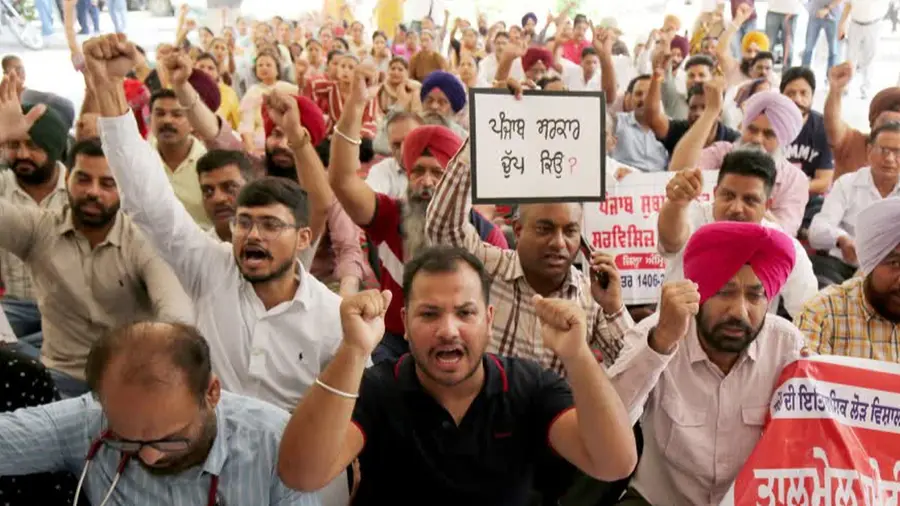
Chandigarh, Punjab: The continuing agitation by Punjab government employees reflects growing anger over the prolonged denial of their legitimate service and social-security rights. More than three lakh Punjab government employees have taken mass casual leave demanding an end to the government’s delay on issues pending for years.
Mean while contractual roadways workers have extended their strike indefinitely. The ongoing strike by the Punjab Roadways, PUNBUS and PRTC Contract Workers’ Union has disrupted bus services across the state. Talks between the workers’ representatives and the government have failed to yield a breakthrough, prolonging the disruption.The twin protests have disrupted bus services and work in government offices, increasing pressure on the Aam Aadmi Party (AAP) government ahead of the 2027 Punjab Assembly elections.
The Punjab government has termed the mass casual leave protest by employees as “unauthorised absence”, escalating tensions between the government and its workforce. Employee organisations have called for negotiations to resolve the long-pending demands and urged the government to engage with their representatives.
The employees’ principal demands include release of the pending 18% DA arrears, restoration of the Old Pension Scheme (OPS), implementation of the 2.59 multiplication factor, restoration of ACP benefits, and regularisation of contractual and outsourced employees.
Employees Demand Release of DA Arrears
Punjab government employees have demanded the immediate release of pending dearness allowance (DA) arrears, arguing that rising inflation has increased the cost of living and eroded their purchasing power. Employee organisations have called for the release of the outstanding arrears and other pending financial benefits, stating that workers should not bear the burden of the state government’s financial difficulties.
Employees Seek Restoration of Old Pension Scheme
The restoration of the Old Pension Scheme (OPS) is another key demand of the agitating employees. They have called for guaranteed post-retirement social security, opposing a pension system linked to market performance. The employees maintain that those who have served the government for decades must be assured financial security after retirement.
Demand for Regularisation of Contractual Employees
Employee organisations have also raised concerns over the growing dependence on contractual and outsourced workers in government services. They have demanded the regularisation of eligible workers, an end to contractualisation for permanent jobs and equal pay for equal work.
They argue that prolonged contractual employment undermines job security and creates disparities among workers performing similar duties. The organisations have called for secure employment and better service conditions for all eligible workers.
Employees Raise Concerns Over Public Services
The agitation has also brought attention to concerns over regular recruitment, outsourcing and the future of public services. Employee organisations have stressed the need to strengthen government institutions and ensure adequate public investment in education, healthcare, public transport and social security.
They have called for public funds to be directed towards essential services and the welfare of ordinary people rather than policies that promote private profiteering.
Unions Call for Negotiations With Government
Employee organisations have urged the Punjab government to initiate meaningful, time-bound negotiations to resolve the long-pending demands. They have stressed that the agitation extends beyond the issue of casual leave and concerns wages, pensions, job security, social security and the future of public employment.
The organisations have called on the government to address their grievances through dialogue and concrete decisions rather than confrontation or threats.
